Guide
How to Check How Old a Domain Is, and When the Date Lies
Look the domain up at lookup.icann.org and read the created date. That's the day the current registration began. Then search the name in the Wayback Machine. If its oldest saved page is years older than that created date, the name was dropped and bought again, and the site you see now may have a different owner.

Three Things to Know
- Since January 28, 2025, ICANN's RDAP lookup is the official place to read registration dates for names like .com and .net.
- In our October 30, 2026 check of 255 small business domains, 49 had saved web pages more than a year older than their registration date.
- A domain that expires and gets deleted starts over with a new created date when the next person registers it.
You'll hear that a domain age checker tells you how long a business has been online, and that the date can't be faked. The date is real. But it marks when the current registration started, not when the name first existed. When a name is deleted and someone registers it again, the record starts over. RDAP, the system behind ICANN's lookup, even has a separate event called reregistration for that.3
That's why I check two dates, not one. It takes about two minutes, and it's free.
Check the Registration Date in One Minute
For .com, .net and the other generic endings, the registration record now comes from RDAP. ICANN made RDAP the official source for that data on January 28, 2025, in place of the old WHOIS system.1
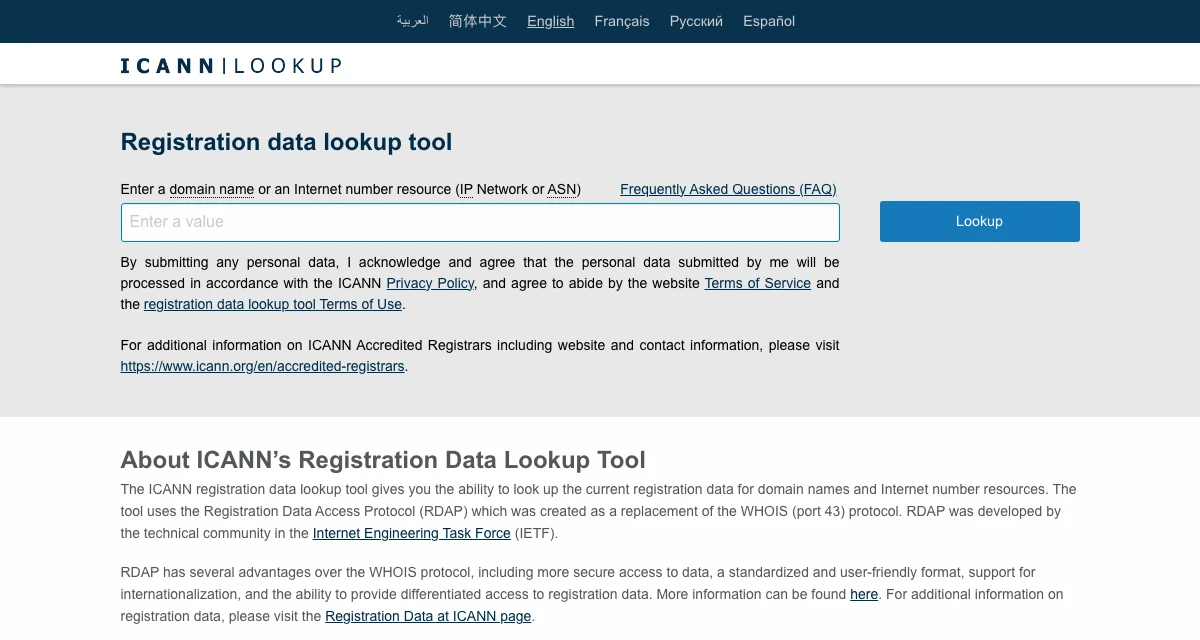
- Go to lookup.icann.org, ICANN's free lookup tool.2
- Type the domain without the www, like example.com, and press Lookup.
- Find the date marked created or registration. That's the domain's age on paper.
- Note the expiration date and the registrar while you're there.
Free age checker sites read the same record and do the math for you. That's fine for a quick look. Just know where the number comes from.
What Each Date in the Record Means
The record lists events, each with a date. The RDAP standard names them.3
| Event in the record | What it tells you |
|---|---|
| Registration (created) | When this registration began3 |
| Reregistration | The name was registered again after it was let go3 |
| Last changed | The record was edited, like new nameservers3 |
| Expiration | When it runs out unless someone renews it3 |
| Transfer | It moved to another registrar3 |
Last changed doesn't mean the owner changed. It can be as small as a DNS update. And a transfer is its own event, separate from registration. So moving a domain to another registrar shouldn't reset the created date.
Then Check the Wayback Machine
The Internet Archive's Wayback Machine has saved copies of web pages going back to the 1990s. Its oldest saved copy of a domain shows when a site first lived at that name.
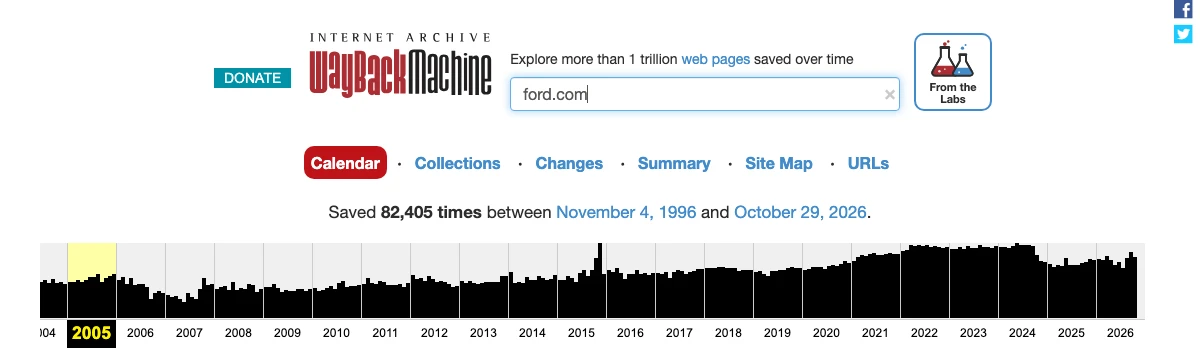
- Go to web.archive.org and type the domain.
- Read the line that says saved so many times between two dates. The first date is the oldest copy.
- Click a capture from that first year to see what the site was.
Checking a lot of names? The Archive's CDX server returns the oldest capture in one line. Ask for one result with only the timestamp field, and the first row back is the oldest copy.5
https://web.archive.org/cdx/search/cdx?url=example.com&limit=1&fl=timestamp
Now compare the two dates. If the oldest saved page is about the same as the created date, the name has likely had one run. If the saved pages are years older, someone held that name before.
What We Found on 300 Business Domains
I wanted to know how often those two dates disagree on real small business sites. So on October 30, 2026 we took 300 .com and .net domains at random from the 20,097 auto repair shop domains we track. We looked up each one in the .com and .net registry and in the Wayback Machine.
- 13 of the 300 weren't registered anymore. Each was still listed as a shop's website.
- The median registration year was 2019. 132 were registered in 2020 or later. Only 7 date back to the 1990s.
- 255 had both a registration date and saved pages we could compare. 30 had never been saved.
- 49 of those 255 had saved pages more than a year older than their registration date. That's 19 percent. For 34 of them the gap was more than five years, and the widest was about 24 years.
- 14 of the 49 were registered in 2026. Their record says the domain is months old. The Archive has their pages from years before.
A gap doesn't always mean a stranger. Sometimes a shop let its own name lapse and bought it back. But either way, the created date undersold how long that name has been on the web, or it hid an earlier owner.
When the Created Date Lies
The created date resets when a name is deleted. Under ICANN's expired domain policy, a deleted name sits in a 30 day redemption grace period, when the old owner can still get it back.4 If the old owner doesn't restore it, the name is released, and whoever registers it next starts a fresh record.
So a created date can mislead you three ways.
- Too young. A shop that has used its name for 15 years shows a 2026 date because it lapsed once.
- Hiding a past. A name with a new date may have run a casino or spam site for years before. That history can follow it.
- Too old for the business. A domain from 2005 can belong to a shop that opened in 2022 and bought an old name.
One domain in our check showed a redemption period status. That name has been deleted, but its owner can still restore it for a short time. Our guide to what happens when a domain expires walks through that clock.
Before You Buy an Older Domain
Run both checks before you pay for any name, new or used.
- Read the created date at lookup.icann.org.
- Open the oldest Wayback capture and a few from each year after. Look for spam, adult content or a different business.
- Check the status line. A name in redemption or pending delete isn't really for sale yet.
- Search the name in quotes on Google to see where it still shows up.
- Ask the seller why they're selling. A clean answer is worth more than an old date.
If you're weighing whether a name is worth buying at all, our guide to domain name value covers what names really sell for. To see who controls a name and who hosts it, use our guide on how to find out who owns a domain.
Get Help With Your Domain
T3CHS registers and renews domains for small businesses and keeps the renewal date in view, so your name never lapses. Call or text (949) 65-T3CHS, or send us the domain you're looking at and we'll read its history with you.
Before You Call
How can I check how old a domain is for free?
Type the domain into lookup.icann.org and read the created date. Then search it on web.archive.org and look at the date of the oldest saved copy. The two together tell you how long the name has existed and whether it changed hands.
Does domain age reset when a domain is transferred?
Moving a domain to a new registrar is logged as its own transfer event, so it shouldn't change the created date. The date resets when a domain is deleted and someone registers it again.
Why does a domain age checker show a different date than the Wayback Machine?
The checker shows when the current registration began. The Wayback Machine shows the oldest saved page. If the pages are older, the name was likely deleted and registered again, so it had an earlier owner or an earlier run.
Can I check the age of a domain that isn't .com?
Yes for most generic endings, like .net, .org and the newer ones, through ICANN Lookup. Country endings run their own registries, so their records may show different fields or less detail.
Is an older domain better for my business?
Not on its own. An old name with a clean history and real links can help. An old name that ran spam can hurt. Check the history before you pay more for age.
Cited Pages
- ICANN: Launching RDAP, Sunsetting WHOISicann.orgOpened October 2026
- ICANN Lookuplookup.icann.orgOpened October 2026
- RFC 9083: JSON Responses for RDAP, Event Actionsrfc-editor.orgOpened October 2026
- ICANN: Expired Registration Recovery Policyicann.orgOpened October 2026
- Internet Archive: Wayback CDX Server APIgithub.comOpened October 2026
Last reviewed November 1, 2026.
See more of our reporting when you search.
Want T3CHS first in Google? Set us as a preferred sourceWhere This Leads
Put it to work
- Domain Names for Local BusinessRegister or move the name customers type in.
- DNS LookupSee the A, MX, TXT, NS and other records for any domain.
More guides
- How to Find Out Who Owns a Domain and Who Hosts ItLook up the domain at lookup.icann.org to see its registrar and dates. Owner details are often hidden for privacy, so the registrar is your main lead. A DNS lookup then shows who hosts the website and who runs the email.
- What Happens When Your Domain ExpiresWhen a domain expires, your website and email stop working soon after, but you usually still have time to renew. Under ICANN rules you get reminders before the date, a window to renew after it, and often a 30 day restore period after that.
- Domain Name Value: Who Would Pay for Yours and How MuchTo a buyer, most small business domains are worth close to nothing, because the names that sell for real money are short, generic words. To you, the same domain can be worth a lot, because your email, your printed cards and every link to your site run through it. Price the second number before you answer any offer.
- All GuidesEvery guide in one place.
Look up a term
- Tech GlossaryPlain meanings for 49 tech words.